
Data Ingestion vs ETL: What's the Difference?
Data ingestion moves raw data. ETL transforms it first. Learn when to use each, how they work together, and why modern teams are choosing ELT instead.

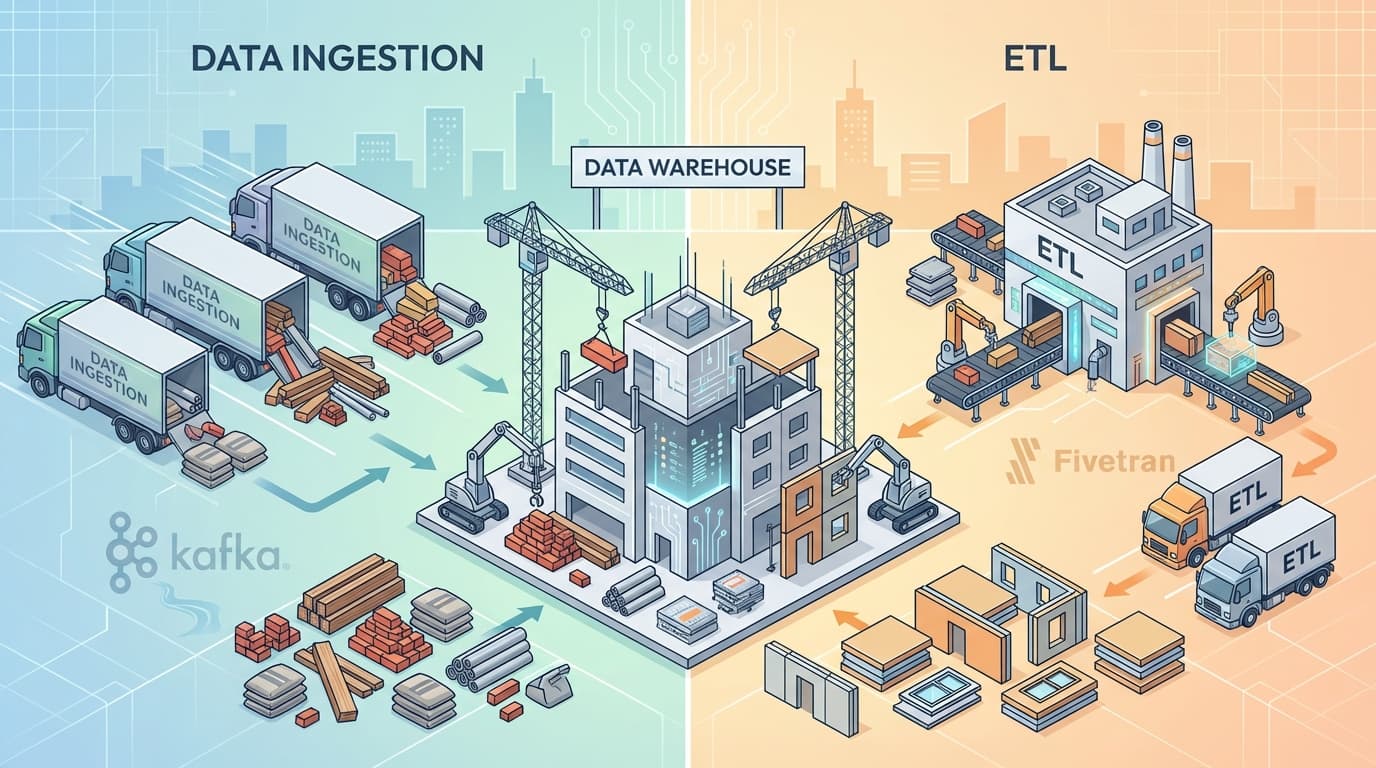
Data ingestion moves raw data from point A to point B. ETL goes further by transforming data before loading it. The simplest way to think about it:
- Data Ingestion = E + L (Extract and Load)
- ETL = E + T + L (Extract, Transform, then Load)
Choose wrong and you'll either over-engineer a simple data movement task or skip transformations your business actually needs. This guide breaks down when to use each approach, how they work together, and why ELT is changing the game.
What is Data Ingestion?
According to Qlik, "Data ingestion refers to the tools & processes used to collect data from various sources and move it to a target site, either in batches or in real-time."
Think of it like bringing groceries home. You grab items from the store and put them in your fridge. Raw ingredients, untouched, waiting to be used later. You haven't cooked anything yet. You haven't even decided what to make for dinner. The groceries are just... there.
The data ingestion layer is the entry point for your entire data pipeline. It collects from APIs, databases, files, streams—whatever you've got—and dumps everything into a central location. Data lakes, staging areas, landing zones. The data arrives in its original format.
Atlan puts it simply: "Data Ingestion is the process of collecting raw data from disparate sources and transferring it to a centralized repository."
Batch vs. Streaming Data Ingestion
Not all data ingestion works the same way.
Batch ingestion runs on a schedule. Every hour. Every night. Every Sunday at 2 AM. You collect data over time and move it all at once. Good for reports, historical analysis, and situations where real-time doesn't matter.
Streaming data ingestion happens continuously. Data flows in as it's generated. Stock tickers. IoT sensors. Social media feeds. If you need to react immediately, you need streaming.
Common tools for data ingestion include Apache Kafka, Amazon Kinesis, Apache NiFi, and Flume. These specialize in moving data fast without getting in the way of what comes next.
Why Keep Data Raw?
Sometimes you don't know what you'll need yet. Raw data gives you flexibility. You can transform it later when requirements become clear. This "schema-on-read" approach is popular with data lakes—store everything now, structure it when you actually use it.
There's another reason: audit trails. Keeping raw data means you can always trace back to the source. If a number looks wrong in a report, you can check what the original data actually said. Transform the data, and you might lose that ability.
What is ETL?
ETL stands for Extract, Transform, Load. It's been around since the 1970s, according to Astera, and it's still the backbone of most business intelligence systems.
Here's what each step does:
Extract – Pull data from source systems. Databases, APIs, files, spreadsheets. This is the data ingestion part.
Transform – Clean, standardize, and restructure the data. Remove duplicates. Fix formatting. Convert currencies. Join related records. Apply business rules.
Load – Write the transformed data to your target system, usually a data warehouse.
The transform step is what separates ETL from simple data ingestion. As IBM notes (via Atlan), "Through a series of business rules, ETL cleanses and organizes data in a way which addresses specific business intelligence needs."
Back to the grocery analogy: ETL is like preparing, cooking, and serving a meal. You don't just bring ingredients home—you wash them, chop them, combine them, and plate something ready to eat.
The Transformation Difference
Transformation isn't just formatting. It's making data usable.
A G2 report explains: "Data transformation empowers organizations to make use of data, irrespective of its source, by converting it into a format that can be easily stored and analyzed for valuable insights."
Without transformation, you're stuck with data that:
- Uses different date formats (2023-01-15 vs 01/15/2023 vs 15 Jan 2023)
- Contains duplicates across systems
- Has inconsistent naming (NY, New York, NYC, N.Y.)
- Mixes currencies, units, or languages
ETL tools like Fivetran, Stitch, Informatica, and Talend handle this heavy lifting. They let you define transformation rules once and apply them every time new data arrives.
Key Differences at a Glance
| Aspect | Data Ingestion | ETL |
|---|---|---|
| Definition | Moving raw data from sources to a central location | Complete pipeline: extract, transform, then load |
| Primary Focus | Data movement and collection | Data transformation and standardization |
| Transformation | Minimal to none (data moved as-is) | Extensive (cleaning, standardizing, enriching) |
| Data State | Raw, original format | Cleaned, structured, analytics-ready |
| Complexity | Relatively straightforward | More complex due to transformation logic |
| Timing | Real-time or batch | Traditionally batch (scheduled intervals) |
| Destination | Data lake, staging area, landing zone | Data warehouse (structured repository) |
| Development Time | Faster to implement | Longer due to transformation logic |
| Data Quality | Basic validation only | Deduplication, cleansing, validation |
The important thing to understand: data ingestion is part of ETL. The "E" in ETL is essentially data ingestion. But ETL wraps it in additional steps that make data ready for business use.
Most articles about data ingestion vs ETL miss this relationship. They treat them as separate, competing options. They're not. Data ingestion is a building block. ETL is a complete workflow that includes that building block plus more.
When to Use Data Ingestion
Data ingestion alone makes sense when:
You need real-time data. Stock trading platforms. Fraud detection systems. IoT monitoring. When milliseconds matter, you can't wait for transformation. Ingest the data, analyze it raw, react fast.
You're building a data lake. Store everything. Worry about structure later. Data lakes thrive on raw data from dozens of sources. Transformation happens downstream, when you actually query.
Source and target systems are compatible. If your source already produces clean, structured data in the right format, why transform it? Move it and move on.
You're collecting logs. System logs, application logs, security logs. Often most valuable in their raw state. Timestamps, error codes, stack traces—transformation might lose information.
Cost matters more than polish. Large volumes. Tight budgets. If you just need data accessible without analytics-ready formatting, ingestion alone keeps costs down. You can always add transformation later when the budget allows or when specific use cases demand it.
Industries that rely heavily on data ingestion:
- Finance (real-time trading feeds)
- Retail (inventory updates)
- IoT/manufacturing (sensor streams)
- Social media (content monitoring)
When to Use ETL
ETL makes sense when:
You need business intelligence and reporting. Dashboards, KPIs, executive reports—these need clean, consistent data. ETL ensures everyone sees the same numbers.
Regulatory compliance demands specific formats. Healthcare. Finance. Government. When auditors come knocking, your data better be standardized and documented.
You're combining data from multiple sources. Customer data in Salesforce. Orders in Shopify. Support tickets in Zendesk. Different systems, different formats. ETL merges them into one coherent view.
Data quality is non-negotiable. Medical records. Financial statements. Anything where bad data has real consequences. ETL catches issues before they reach decision-makers.
Historical analysis requires consistency. Comparing this year's revenue to last year's? Both datasets need identical formatting. ETL ensures apples-to-apples comparisons. Without it, you're comparing data that might use different currencies, different fiscal calendars, or different categorization schemes.
Industries that depend on ETL:
- Healthcare (electronic health records)
- Banking (compliance reporting, fraud analysis)
- Manufacturing (quality control metrics)
- Retail (customer analytics across channels)
ELT: The Modern Hybrid
Here's what's changing the game: ELT.
Same letters. Different order. Big implications.
ELT = Extract, Load, Transform
Instead of transforming before loading, ELT loads raw data first and transforms it inside the data warehouse. Why? Modern cloud warehouses like Snowflake, BigQuery, and Redshift have massive processing power. They can handle transformation at scale, often faster than traditional ETL tools.
Benefits of ELT:
- Faster initial loads (no transformation bottleneck)
- Raw data preserved (transform again if requirements change)
- Leverages warehouse compute power you're already paying for
- Better for unstructured and semi-structured data
- Easier to iterate on transformation logic without rebuilding pipelines
Tools like dbt have made ELT popular by letting analysts write transformations in SQL, running directly in the warehouse. This shifts transformation work from specialized ETL engineers to the analysts who actually understand the business logic. Faster iterations. Fewer handoffs.
Gartner noted that "The demand to capture data and handle high-velocity message streams from heterogeneous data sources is increasing." ELT meets this demand by separating ingestion speed from transformation complexity.
How They Work Together
In practice, most modern data pipelines use both approaches.
A typical architecture looks like this:
- Data ingestion streams or batches raw data into a staging area
- ELT transforms staged data into analytics-ready tables
- Business tools query the transformed data for reports and dashboards
Each layer has its own tools, its own team responsibilities, and its own failure modes. The staging area acts as a buffer—DZone describes it as "a storage layer, which acts as a staging area for data... The goal of this layer is to provide a delivery entry point for the different data sources."
The moving house analogy works here: data ingestion is putting everything in boxes and moving them to your new place. ETL (or ELT) is unpacking, organizing, and arranging everything so you can actually live there.
Lambda architecture takes this further:
- Speed layer: Real-time data ingestion for immediate needs
- Batch layer: ETL for historical, thoroughly-processed data
- Serving layer: Unified access for applications and queries
This hybrid approach gives you both—real-time responsiveness and deep historical analysis. It's more complex to build and maintain, but for organizations that need both speeds, it's often the right answer.
Making the Right Choice
Ask yourself these questions:
Do you need data immediately? Yes → Focus on data ingestion No → ETL is fine
Is the data already clean and structured? Yes → Data ingestion alone may suffice No → You'll need transformation (ETL or ELT)
Are you building a data lake or a data warehouse? Data lake → Prioritize ingestion Data warehouse → ETL or ELT
Do multiple teams need consistent data definitions? Yes → ETL to standardize No → Ingestion may be enough
What's your budget for tooling and development? Limited → Start with ingestion, add transformation later Flexible → Build a full ETL/ELT pipeline
According to McKinsey, businesses that intensively use customer analytics are 23 times more likely to succeed at customer acquisition and 19 times more likely to be highly profitable. But analytics only works when data is accessible and trustworthy. That means getting both ingestion and transformation right—the former for availability, the latter for quality.
Getting Started
You don't have to build everything at once.
Many teams start with data ingestion—getting data flowing into a central location. Once that's working, they add transformations piece by piece. Move fast, then refine.
If you're working with CSV files, Excel spreadsheets, or similar tabular data, tools like ImportCSV handle the ingestion step automatically. Upload a file, map columns to your database schema, and the data lands where it needs to go. No code required for the "E + L" part.
From there, you can add dbt or similar tools for the "T"—building out full ELT pipelines as your needs grow.
The bottom line: data ingestion and ETL aren't competing approaches. They're complementary pieces of a larger puzzle. Understanding when each applies helps you build pipelines that are fast when speed matters and thorough when quality counts. Start simple, add complexity only when the use case demands it, and remember that the best data pipeline is the one your team can actually maintain.
Wrap-up
CSV imports shouldn't slow you down. ImportCSV aims to expand into your workflow — whether you're building data import flows, handling customer uploads, or processing large datasets.
If that sounds like the kind of tooling you want to use, try ImportCSV .